
Contents
- · How to compare without a feature checklist
- · Square for Restaurants
- · Toast
- · Lightspeed Restaurant
- · A quick comparison
- · Where KunnPOS fits
- · How to decide in one afternoon
Most fast food POS comparisons end the same way: a feature table with eleven tick boxes, all full. That table tells you almost nothing, because every platform on it passes.
What actually separates these systems is not what they do. It is how they charge you, where your data sits, and what happens when your store count changes. Those three questions matter more than the feature list, and they are the ones the feature table never asks.
This article looks at Square, Toast and Lightspeed — three platforms that fast food operators shortlist most often — and sets out a framework for comparing them against your own operation.
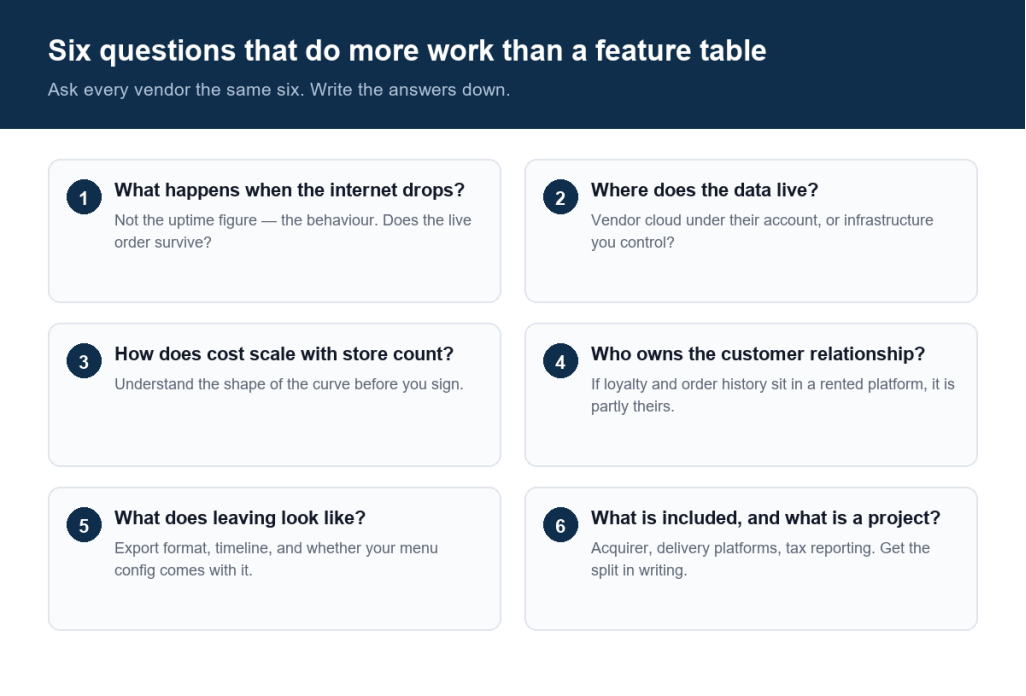
Six questions do more work than an eleven-row feature table.
A note before the details: pricing, market availability and product bundles in this category change frequently, and they vary by country. Confirm current terms directly with each provider before you make a decision. Nothing below should be treated as a quote.
1How to compare without a feature checklist
Six questions do more work than a feature table. Ask each vendor all six, and write the answers down.
1. What happens when the internet drops?
Not the uptime percentage. The behaviour. Can the till keep taking orders and printing while offline, and does the data sync back without duplicates?
2. Where does the data live?
On the vendor's cloud under their account, or on infrastructure you control? The answer determines your compliance position and your exit costs.
3. How does cost scale with store count?
Per-store pricing means the same software costs more as you grow. Understand the shape of the curve before you sign, not after store four.
4. Who owns the customer relationship?
If loyalty, order history and member data sit inside a platform you rent, the relationship is partly theirs.
5. What does leaving look like?
Ask for the export format, the timeline, and whether your menu configuration comes with it. Vendors that hesitate here are telling you something.
6. What integration work is included, and what is a project?
Local acquirer, delivery platforms, tax reporting. Get the split in writing.
2Square for Restaurants
Square is best understood as a payments company that also provides restaurant software. Its strength is the joined-up package: hardware, payments and software from one provider, with a low-friction entry point that suits a single site opening quickly.
For fast food specifically, the appeal is a simple counter workflow, a kitchen display option, and self-service hardware from the same catalogue.
Strengths
- Fast to set up, and easy to try at small scale
- Payments and software billed together, which simplifies the first year
- Works well for a single location or a very small group
Considerations
- The platform is designed around Square's own processing; the payment relationship comes with the software
- Data sits inside Square's platform rather than on infrastructure you control
- Cost is designed to scale with volume and store count
Best suited to:independent operators and small fast food businesses that want one vendor for payments and POS, and expect to stay with that vendor's payment rails.
3Toast
Toast is built restaurant-first rather than payments-first, and it shows in the depth of restaurant-specific workflow: kitchen displays, online ordering, delivery integration, loyalty and reporting all designed as restaurant features rather than adapted from retail.
It is also the most geographically concentrated of the three. Availability and support are strongest in its home market, which matters if you operate somewhere else — or plan to.
Strengths
- Deep, restaurant-specific feature set rather than a general retail platform
- Strong kitchen display and delivery-order handling
- A large integration ecosystem built for restaurants
Considerations
- Long-term cost typically includes hardware, software and processing together
- Availability and support vary significantly outside its home market
- Like Square, the data sits on the vendor's platform
Best suited to:single-market restaurant groups that want restaurant depth and are comfortable with a subscription and processing bundle.
4Lightspeed Restaurant
Lightspeed is an annual-contract, cloud-based platform with strong inventory and reporting depth, positioned at operators with multiple locations or a mixed retail-and-food business.
For fast food, the inventory and central-reporting side is usually the draw. The trade-off is that some QSR-specific workflows — drive-thru in particular — are less developed than on restaurant-only platforms.
Strengths
- Robust inventory management and reporting across locations
- Suits businesses that also run food retail
- Quote-based contracts that can be negotiated for larger groups
Considerations
- Annual contracts rather than monthly flexibility
- Pricing is quoted, which makes early comparison harder
- QSR-specific workflows are not the primary design centre
Best suited to:multi-location operators with a strong inventory and reporting requirement, who are willing to work within an annual contract.
5A quick comparison
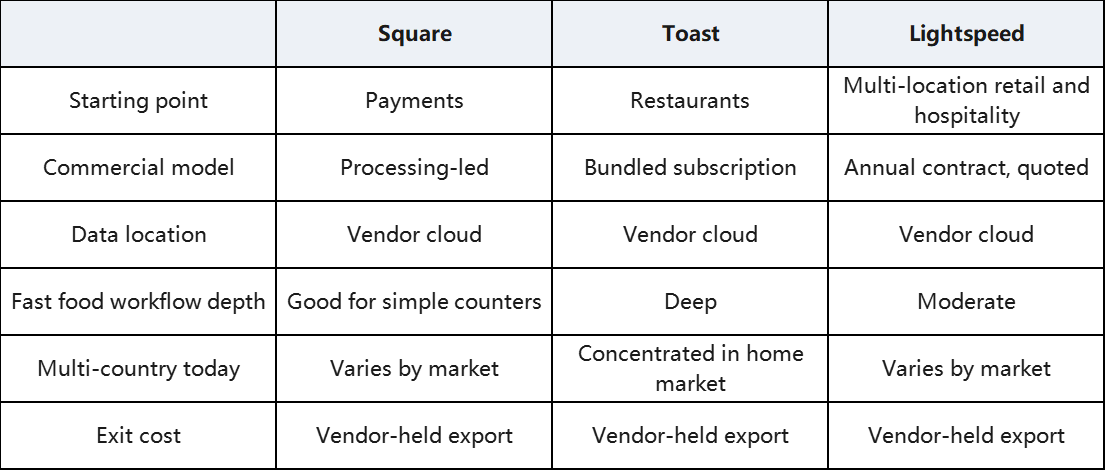
Read this table as a description of design intent, not as a scorecard. All three are competent products. They are simply built around different commercial assumptions — and all three assume the vendor hosts your data.
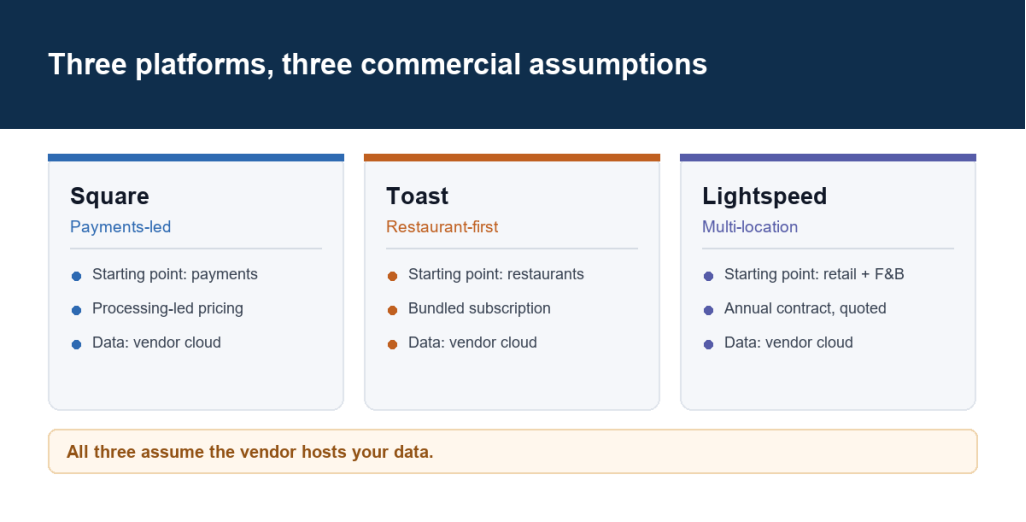
Three platforms, three commercial assumptions. All three host your data.
6Where KunnPOS fits
The three platforms above are subscription businesses. KunnPOS is not: it is a one-time licence for software you host yourself, with the source code available.
That difference changes the answers to the six questions:
- Offline runs locally on the terminal, with queued transactions syncing when the connection returns.
- Data stays on infrastructure you control, which is the practical answer to a GDPR question rather than a policy document.
- Cost does not scale with store count. Open the tenth store without a new software line item.
- The customer relationship — loyalty, member data and order history — stays in your database.
- Exit cost is close to zero, because you already hold the data and the code.
- Integration is scoped explicitly: your acquirer, your delivery platforms and your tax reporting are named deliverables with an owner, not "roadmap items".
We are not claiming this model suits everyone. If you want one vendor to handle payments, hardware and software, and you run one or two sites, the subscription platforms are a reasonable choice.
The one-time licence model suits operators who are planning a rollout — five, ten, fifty stores — and who do not want their software cost to grow in step with their success.
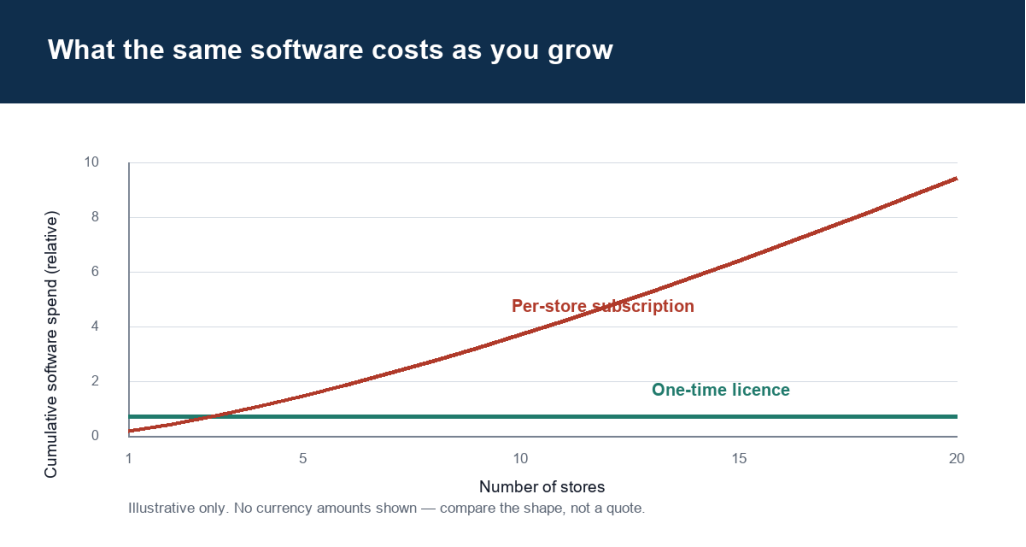
Subscription cost tracks your store count. A one-time licence does not. Illustrative only — no currency amounts.
7How to decide in one afternoon
Run the same afternoon with each vendor, in this order:
1. Ring up a modified order. Count the taps yourself. Anything over three will hurt at peak.
2. Disconnect the network mid-order. Watch what happens to that order.
3. Ask for the three-to-five-year cost at your planned store count, not at your current one.
4. Ask which parts of your integration are included and which are quoted separately.
5. Ask what you receive if you leave, in what format, by when.
Whichever platform answers those five questions best for your operation is the right one — including, sometimes, a platform not on this list.
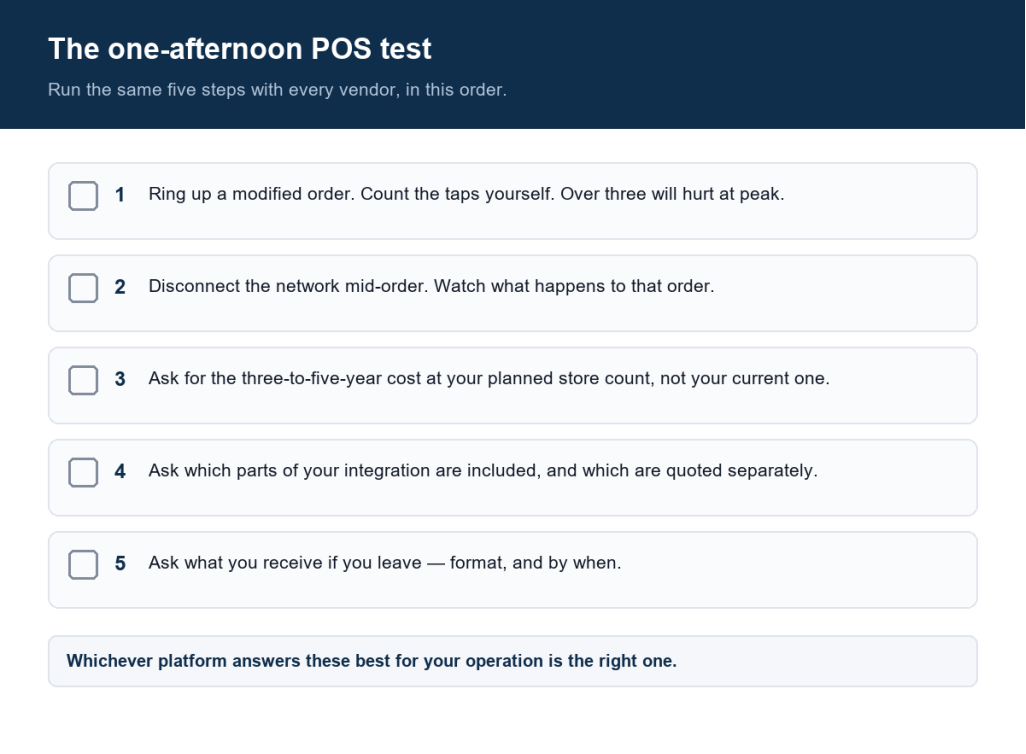
Five questions, one afternoon, every vendor.
*Written by the KunnPOS team. KunnPOS builds privately deployable POS and store-management software for retail and food & beverage businesses. Product names and trademarks mentioned in this article belong to their respective owners and are referenced for identification only. Pricing and feature availability change; confirm current details with each provider before deciding.