
1Introduction
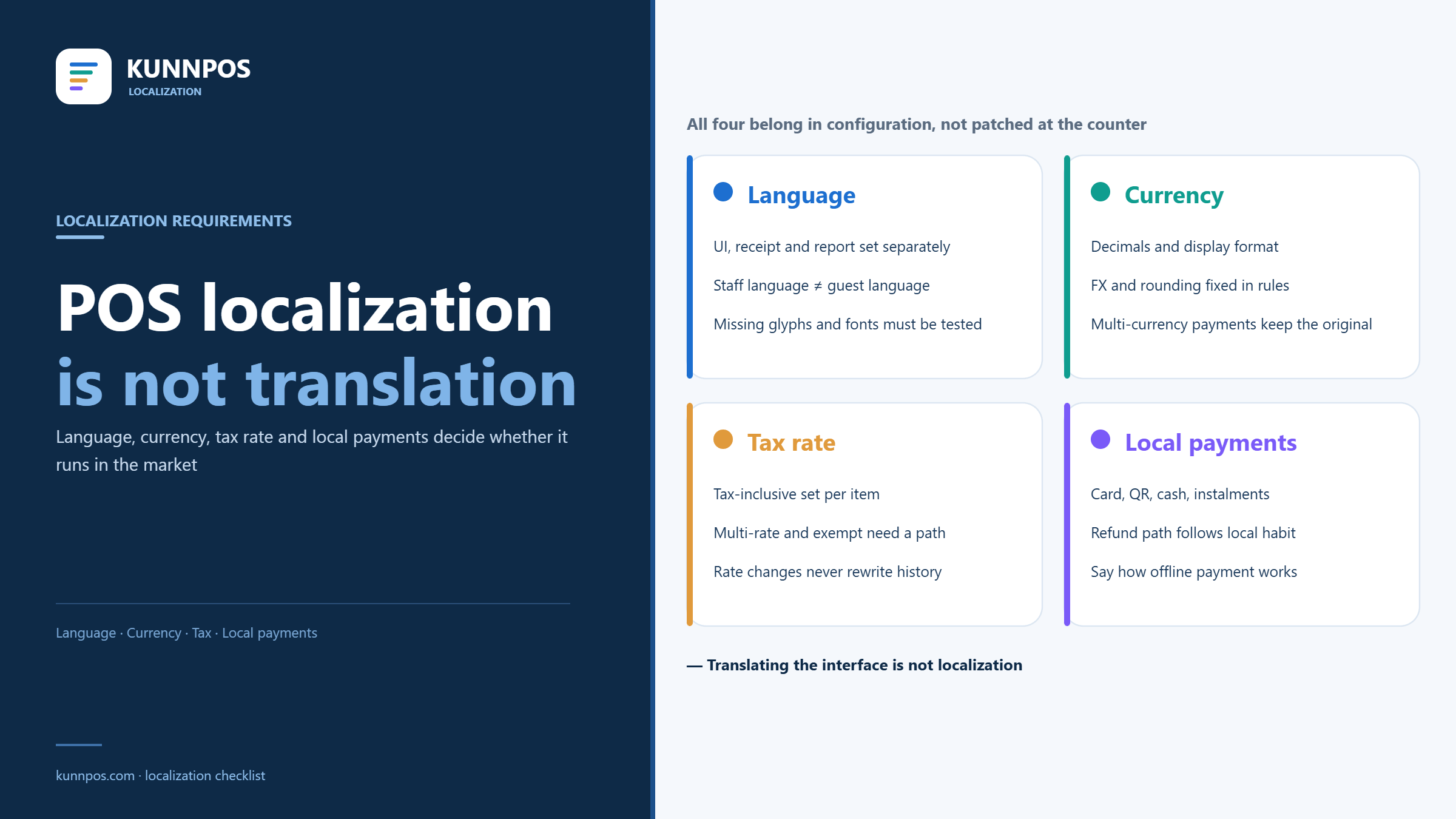
Localization starts with the market, not with a translated button label. A POS used in a new country may need different languages, currencies, tax rules, receipt formats, payment methods, fiscal controls, reporting conventions and support responsibilities. These details affect the transaction model and the operating process together.
A useful localization review asks which market is being served, which local rules are mandatory, which settings can be configured, which integrations depend on a partner and which requirements need a scoped customization project. This article gives operators, software providers and KunnPOS partners a practical framework without assuming that every market has the same standard features. The review should also distinguish what customers see from what staff and administrators must do. A market may require bilingual receipts, local date and time formats, a different tender order, or reports that use local accounting terminology. Each choice should be recorded with an owner and an example transaction.
2Define the market before translating the interface
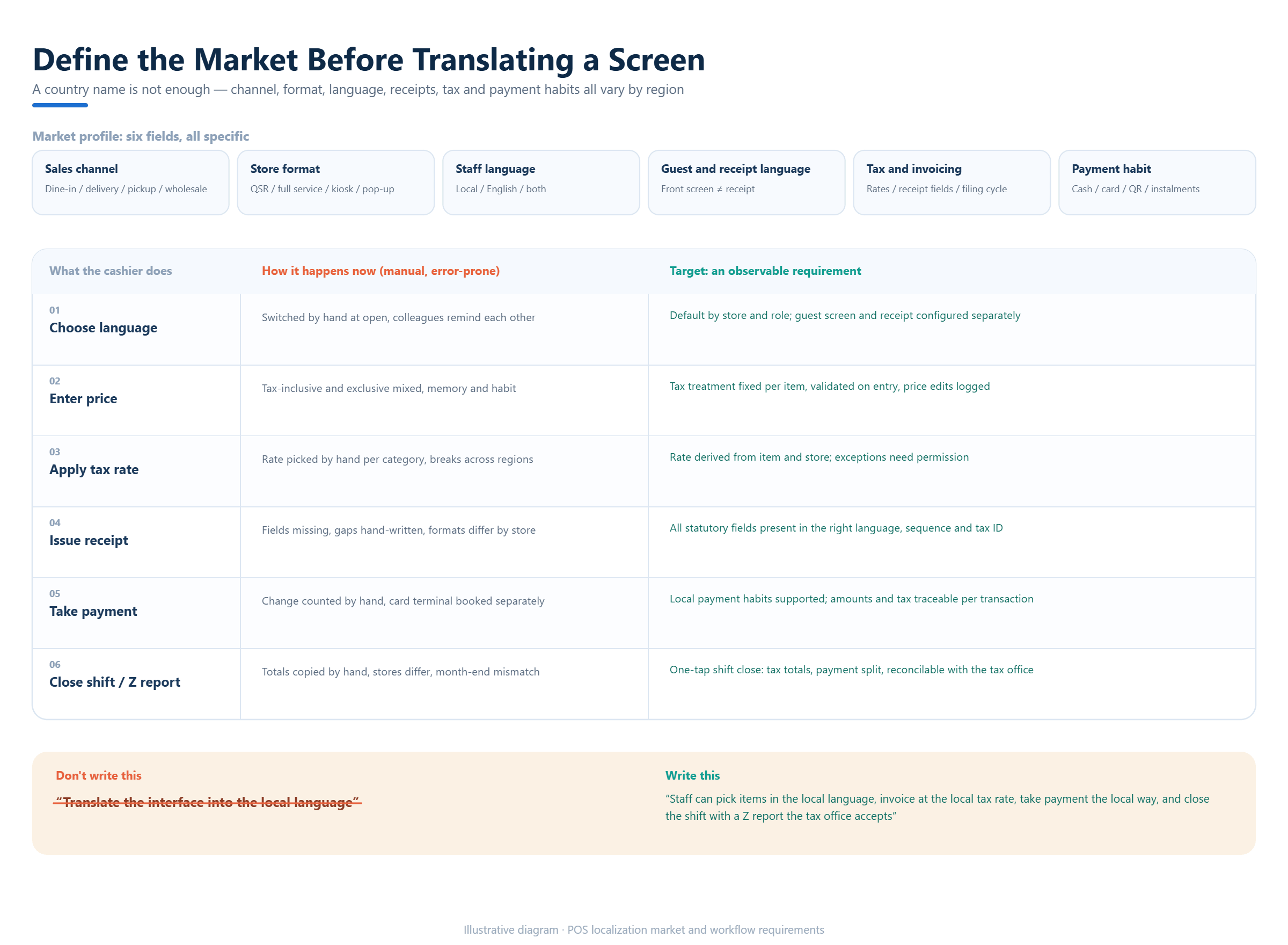
Start with the target market and the operating model. Record the sales channels, store formats, languages used by staff and customers, receipt expectations, tax authority requirements and local payment habits. A country label alone is too broad when regions or business types follow different rules.
Write the current process and the desired process in plain language. Identify where staff select a language, enter a price, apply tax, issue a receipt, accept payment or close a shift. This turns localization into observable requirements rather than a request to translate the interface.
3Separate language from operational localization
Separate language localization from operational localization. List customer-facing labels, staff workflows, printed receipts, reports, help text and administration screens that require local wording. Then list the operating rules that must change even when the interface is translated.
Confirm who owns each local definition. The POS may control sellable items and receipts while an ERP, payment provider or fiscal service controls another record. Record the source of truth, the approval owner and the export requirement for every important entity.
Data ownership also affects exit planning. Confirm how the business will export transactions, integration logs and configuration if a partner, payment service or software contract changes. These questions are part of a responsible custom POS project.
4Plan currency, prices and rounding
Define currency behavior before loading prices. Specify supported currencies, decimal precision, rounding rules, price display, exchange-rate responsibility and whether stores can sell in more than one currency. Document how historical transactions retain the currency used at the time of sale.
Test edge cases such as tax-inclusive and tax-exclusive prices, cash rounding, discounts, refunds and mixed tax rates. If conversion or rounding depends on a partner service, make that dependency visible in the project scope instead of treating it as a standard POS setting.
Middleware can be useful when several systems need the same transformation, monitoring and retry policy. It also creates another operational dependency. Define who owns its credentials, hosting, alerts and upgrades.
5Map tax, receipts and fiscal requirements
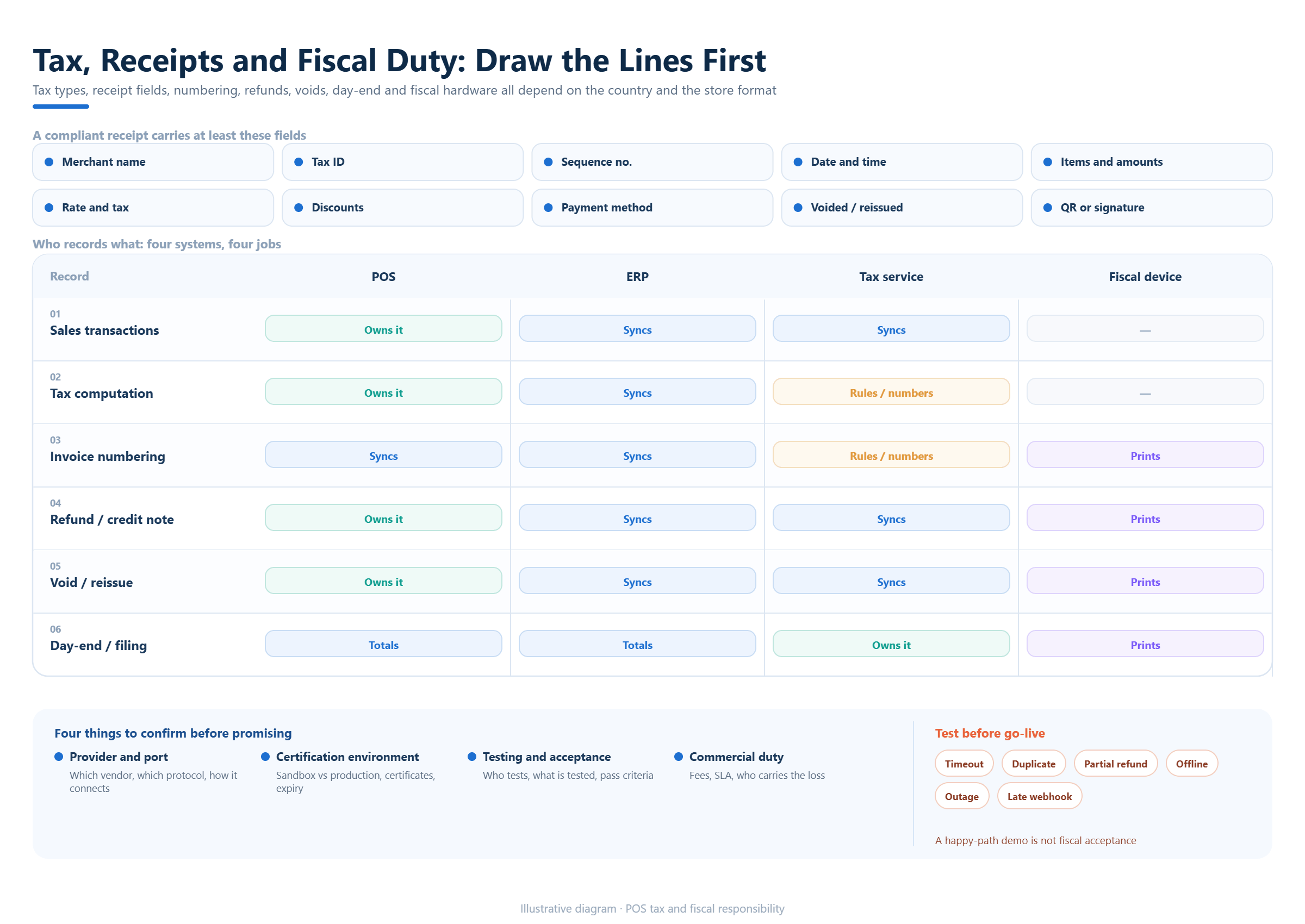
Map tax, receipt and fiscal obligations for the target market. Identify tax categories, invoice or receipt fields, numbering rules, refunds, voids, end-of-day reports and any required fiscal device or certified service. Requirements should be tied to the actual country and business model.
Confirm whether the POS, an ERP, a tax service or hardware is responsible for each record. KunnPOS materials describe local tax connections as project evaluation items; the service provider, certification environment, testing and commercial responsibility must therefore be confirmed before commitment.
Run failure scenarios before launch: timeout, duplicate request, partial refund, offline device, provider outage and a delayed webhook. A successful happy-path demo is not payment acceptance.
6Evaluate local payment and hardware dependencies
List local payment methods and hardware dependencies. Card acquiring, wallets, QR payments, terminals, cash drawers, printers and fiscal devices may vary by market. For each option, record the provider, supported operating mode, callback behavior and who supports the device after launch.
Test authorization, capture, reversal, refund, split payment, offline behavior, timeout and reconciliation. A translated checkout is not localized if staff cannot explain a declined payment or reconcile settlement files with POS transactions.
Use a sample period to compare POS totals, payment settlement and ERP postings. Include zero-value lines, discounts, returns and tax exceptions where relevant. Reconciliation is an acceptance requirement, not an afterthought.
7Protect regional data and access
Protect regional data and access while documenting where information is stored and processed. Identify personal data, payment-related data, prices, credentials and audit records, then confirm the required retention, export and deletion process for the target operation.
For private or customer-owned deployments, confirm backup, monitoring, update responsibility and recovery procedures. Keep test and production credentials separate, limit service-account permissions and record who approves changes to local configuration.
For private or customer-owned deployments, confirm backup, monitoring, update responsibility and recovery procedures. “The API is available” does not define who keeps the integration operating.
8Test reports, support and updates by market
Reports and support must use the market definitions that managers actually need. Check date formats, time zones, tax summaries, payment totals, refund reporting, language in exports and the fields required by local accountants or operators.
Plan update ownership. Tax rules, payment providers, fiscal services and local reporting requirements can change after launch. Define how a change is requested, evaluated, tested, approved and communicated, and identify which changes require a partner or paid customization.
KunnPOS materials describe API, integration and plugin-style customization directions, while the cooperation materials require branding, deployment, source-code, support and local integration terms to be confirmed by project and contract. Use that distinction in every proposal.
9Scope localization as a project
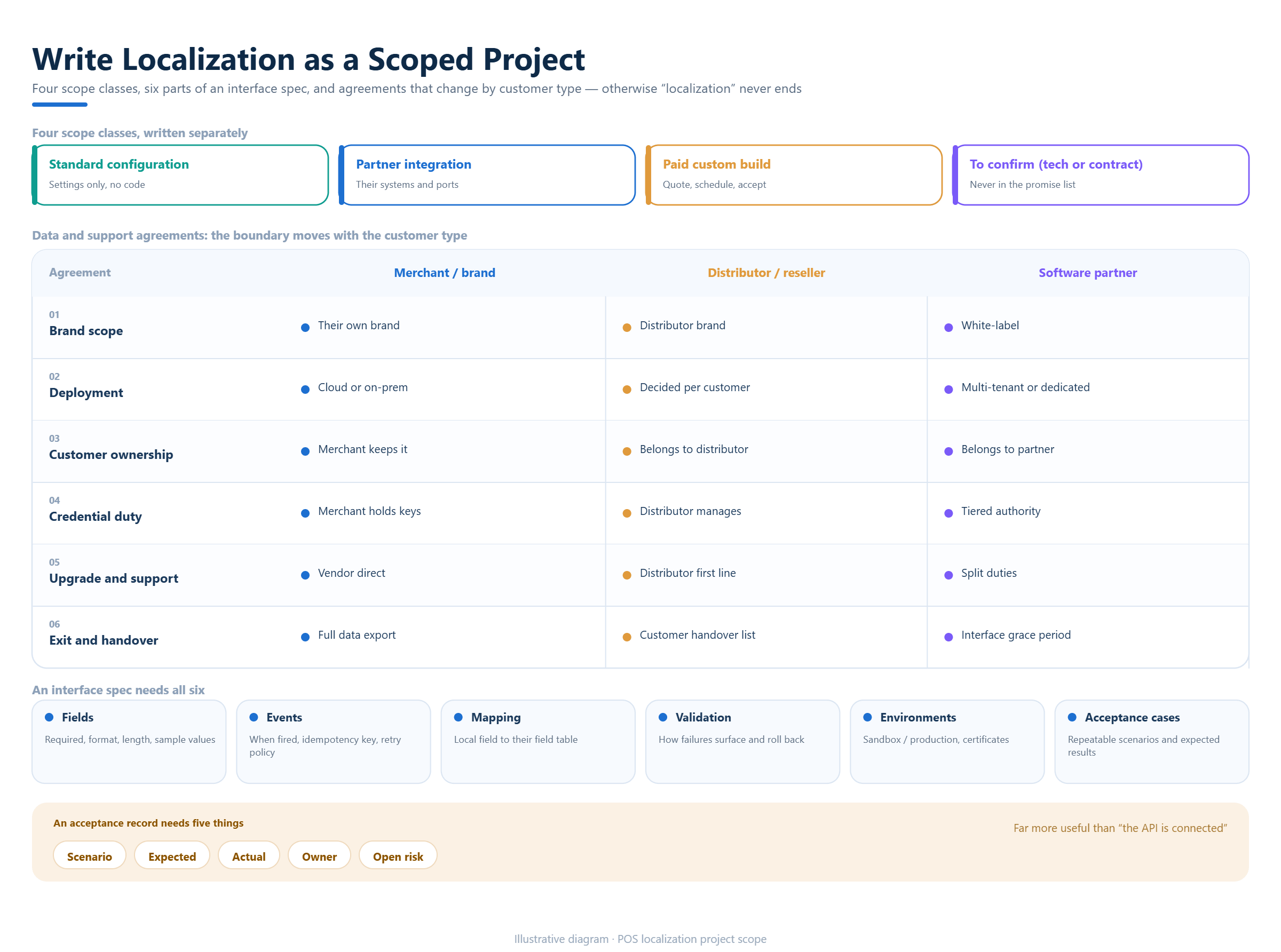
Treat localization as a project with a written scope. Separate standard configuration, partner integration, paid custom development and requirements still awaiting technical or contractual confirmation. A useful interface specification lists fields, events, mappings, validation, environments and acceptance cases.
Define the data and support contract for the localized operation. Branding, deployment model, customer ownership, credential responsibility, escalation, upgrades and exit arrangements may differ for a merchant, reseller or software partner.
The acceptance record should show the scenario, expected result, observed result, responsible party and unresolved risk. This is more useful than a statement that the API was connected.
10Where KunnPOS may fit localization projects
KunnPOS materials describe API, integration, plugin-style customization and local payment or tax connection directions. They also cover restaurant, beverage, retail, wholesale and fresh-food POS contexts. Fit should be assessed against the target market and selected deployment rather than assumed from a feature label.
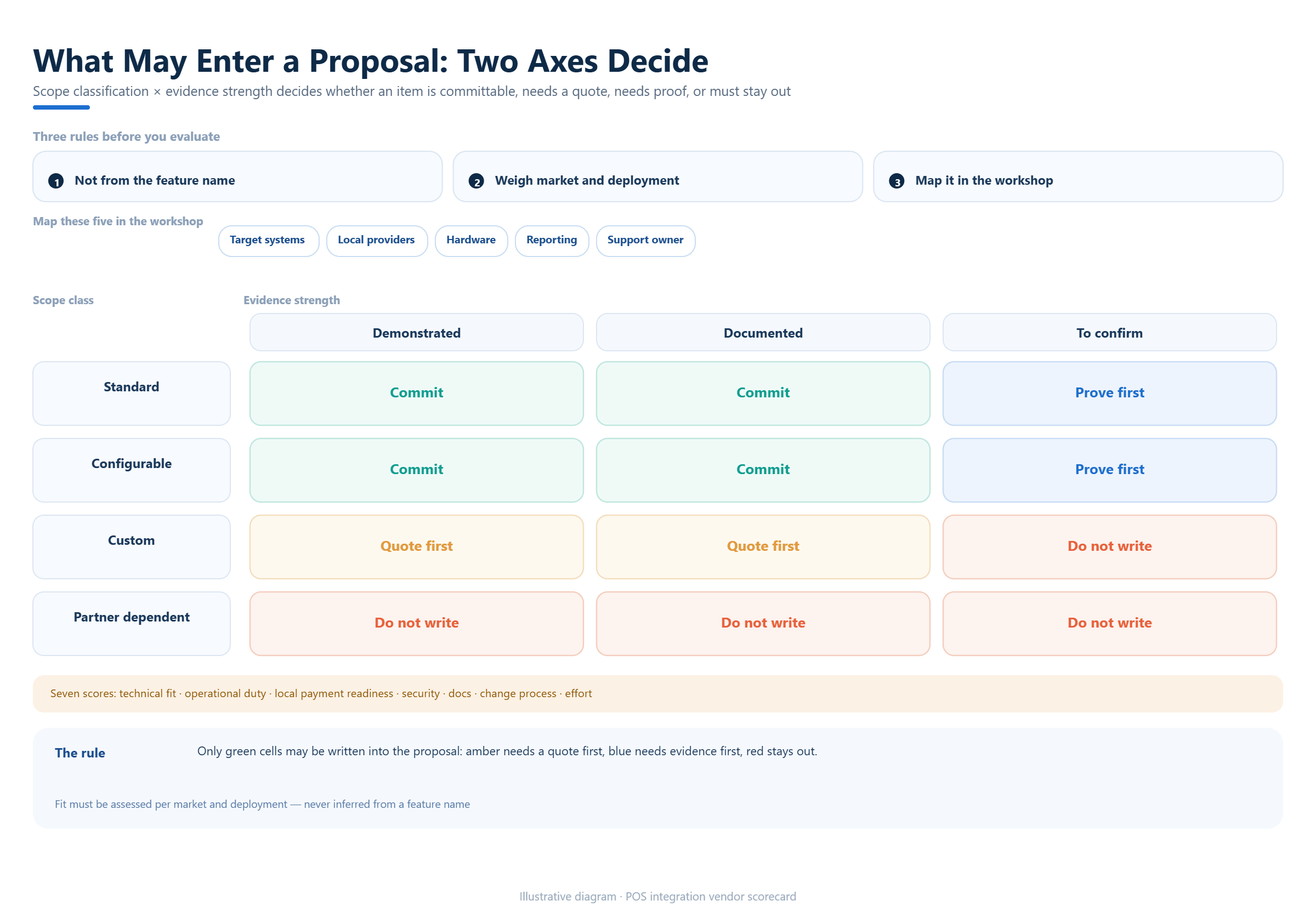
Ask for a requirements workshop that maps the target systems, local providers, hardware, reports and support responsibilities. Mark each item as standard, configurable, custom, partner-dependent or awaiting confirmation so the proposal stays within verified product and contract boundaries.
Score technical fit, operational ownership, local payment readiness, security, documentation, change process and total implementation effort. Mark each answer demonstrated, documented, configurable, custom, partner-dependent or unconfirmed.
11Build a market launch acceptance plan
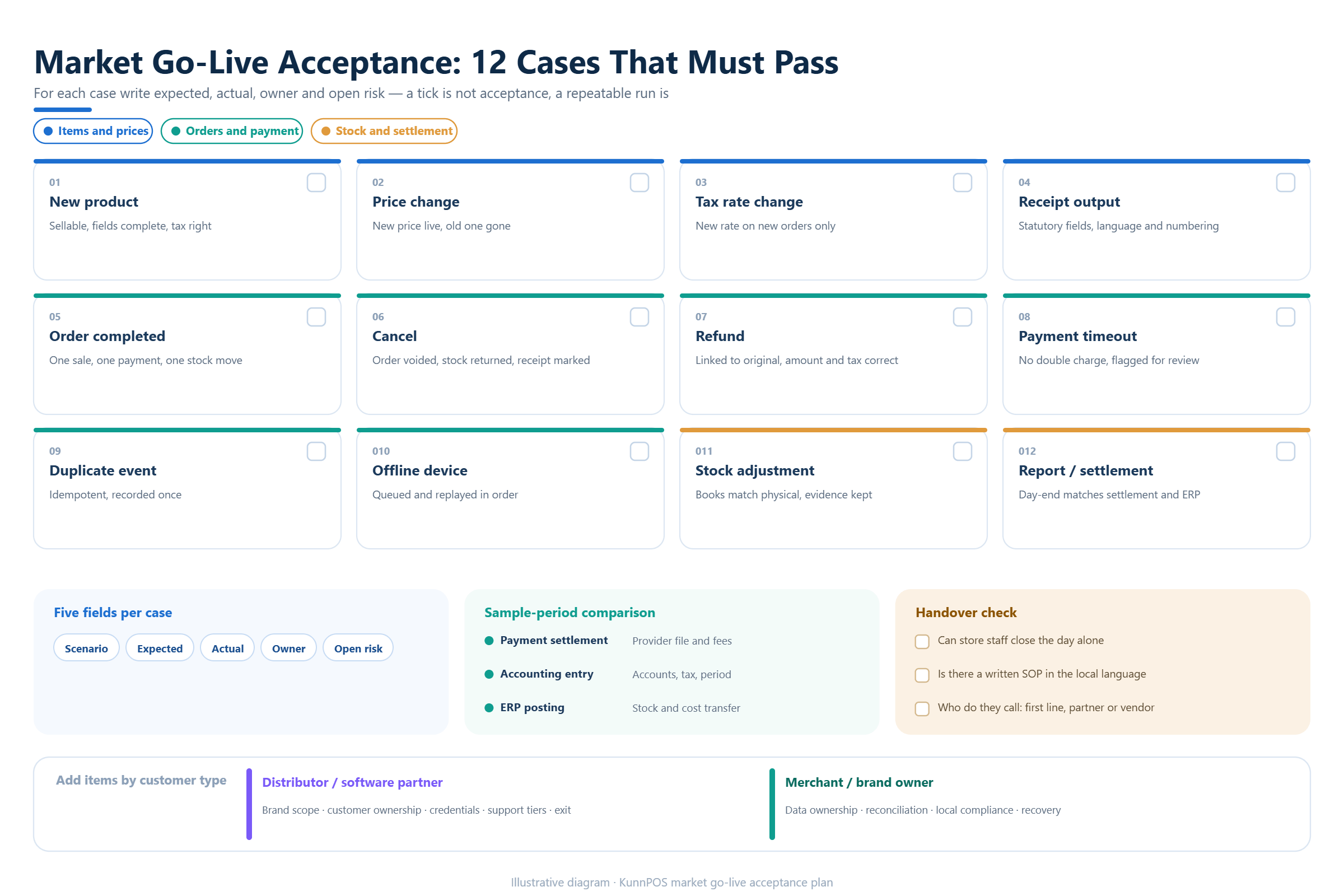
Build an acceptance matrix for the market launch. Include new products, price changes, tax changes, receipt output, completed orders, cancellations, refunds, payment timeouts, duplicate events, offline devices, inventory adjustments and report or settlement results.
Record the expected and observed result, responsible party and unresolved risk for each case. Test a sample period against payment settlement, accounting or ERP postings, and confirm that local configuration remains understandable to store staff after handover.
For a reseller, software provider or partner, add branding scope, customer ownership, credential responsibility, support escalation, upgrades and exit arrangements. For a merchant, focus on data ownership, reconciliation, local compliance and recovery. The same platform can require different project boundaries for different buyers.
12Frequently Asked Questions
13What are POS software localization requirements?
They are the market-specific language, currency, tax, receipt, payment, hardware, reporting, data and support conditions needed for a POS operation.
14Does translating the interface localize a POS?
No. Translation is one layer. Prices, rounding, taxes, receipts, payments, reports, devices and support processes must also fit the target market.
15Who defines local tax and receipt requirements?
The project should confirm the applicable authority, business model, POS or fiscal service responsibility and testing evidence before launch.
16Should every market use the same currency rules?
No. Currency, decimal precision, rounding, exchange-rate ownership and historical transaction handling should be documented for each market.
17Can KunnPOS support a localized POS project?
KunnPOS materials describe relevant API, integration, customization and local connection directions. Actual feasibility depends on the selected version, systems, providers, scope and contract.
18Conclusion
A localized POS is an operating model expressed through software. Define the market, separate language from operational rules, document currency and tax behavior, test local payments and receipts, protect regional data and agree support ownership before launch.
If you are assessing a new market, KunnPOS can help structure a requirements workshop around the actual systems, deployment model and local dependencies. Confirm which items are standard, configurable, custom, partner-dependent or still subject to technical and contract review. The final scope should make uncertainty visible. A requirement marked as configurable needs a configuration test; a partner dependency needs a named provider and environment; a custom item needs a commercial and technical review. This evidence makes localization easier to estimate, train and support. Keep a market decision log so later releases can be checked against the same approved rules and examples. when needed