

Nobody decides to replace a retail POS system on a Tuesday afternoon for fun.
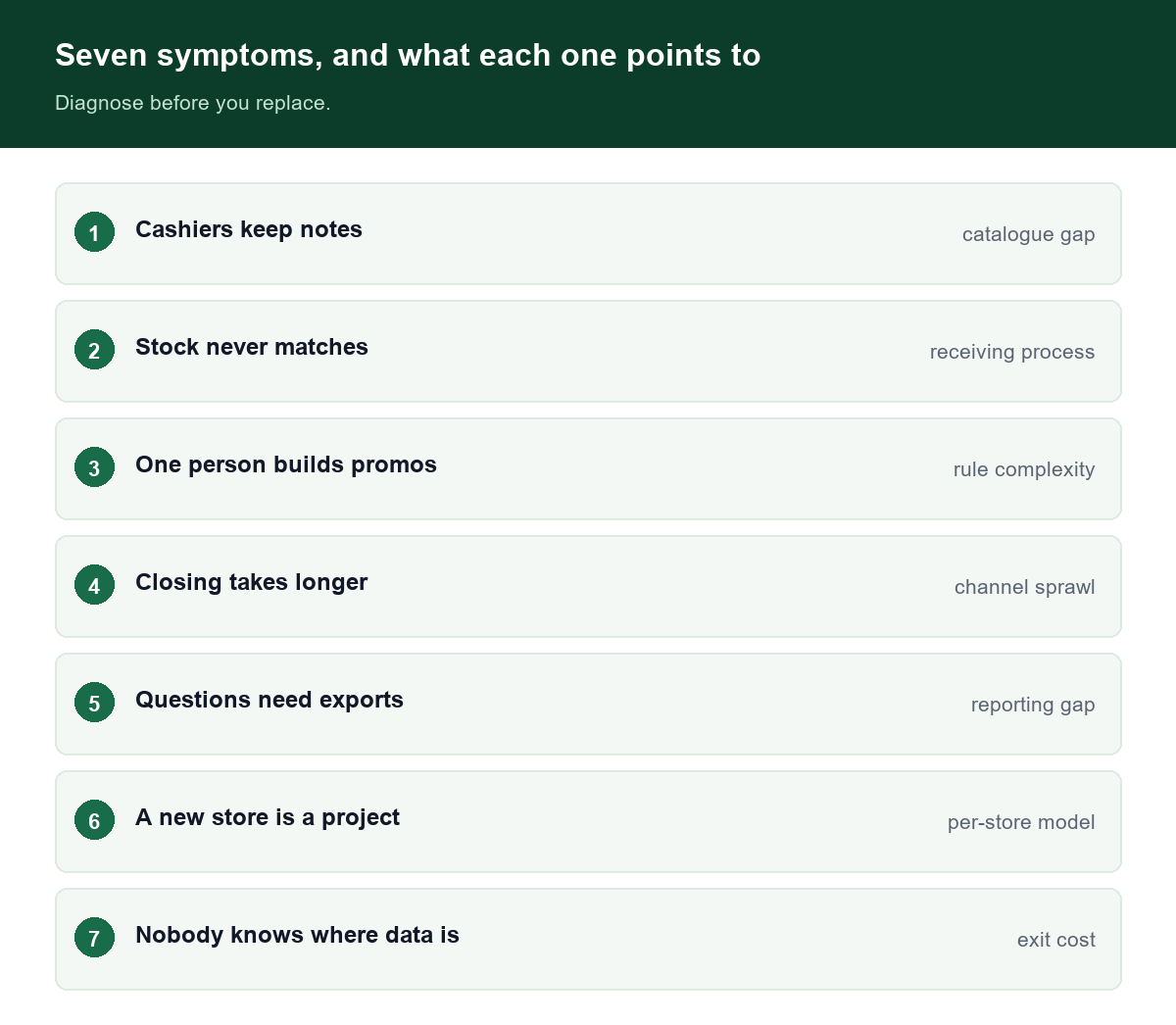
Seven symptoms, and the process behind each one. Diagnose before you replace.
What usually happens is that the system has been failing in small ways for a year, everyone has built a workaround, and the workarounds have quietly become the operating procedure. The stock count is done on a spreadsheet that someone maintains by hand. Two people know how to build a promotion. The month-end reconciliation takes three days.
This article is not a platform comparison. It is a list of seven symptoms, what each one is actually costing, and how to measure whether it is a limitation of the software or a limitation of how it is configured. Some of them you can fix this week without changing anything.
1Your cashiers write things down
a notepad next to the till. A phone with a photo of a delivery note. A running list of items the system "doesn't have".
a mismatch between the product catalogue and reality. Either the SKU is missing, the price is wrong, or the item is configured in a way that makes it slow to reach at the counter.
every manual note is a transaction that will be keyed in later by someone else, or lost. In a store doing 300 transactions a day, a 2% leak is six sales a day with no record of what happened to them.
collect every note and photo for one week. Group them by cause. If more than a handful trace back to the same few items, that is a configuration fix, not a software replacement.
2The stock count never matches the system
you stop trusting the number on the screen and start trusting the shelf. Buying decisions move to "walk the floor and see".
the inventory record has stopped being written to reliably. Causes are usually boring — unreceived deliveries, unrecorded breakages, transfers between stores that were never confirmed, or staff adjustments made without a reason code.
money tied up in stock you did not need. A store holding 15% more inventory than it needs to serve the same demand is financing that excess every month, and it is the least visible cost in retail.
count twenty SKUs at random against the system. If accuracy is below about 95%, the problem is process before it is software. Fix receiving and transfers first, then re-measure.
3Promotions are built by one person
a promotion is requested and someone says "wait for [name], only they can set that up". Or an offer runs longer than planned because nobody wanted to touch it.
either the software genuinely lacks a promotion builder, or the rules are so entangled that changing one breaks another.
marketing runs fewer campaigns than it should — not because they are not worth doing, but because each one has a coordination cost. The campaigns you never ran are invisible in the P&L, which is exactly why they persist.
ask two people who are not the named person to build a second-item offer and a member price on the same order, with no help. If they cannot, you have an operating risk, not just an inconvenience.
4Closing takes longer than it used to
the manager is still at the desk an hour after locking up. End-of-day involves three different reports and a calculator.
channels have multiplied — card, cash, wallets, delivery platforms, e-commerce — and each one has its own settlement, its own fee structure and its own timing. The reconciliation process has grown one exception at a time.
an hour a day per store. At ten stores that is roughly 3,600 hours a year of management time spent on arithmetic instead of on the floor.
time the close for five consecutive days and write down every system you touched. The number of systems is usually the answer.
5You cannot answer a simple question without exporting
"which category made margin last Tuesday?" and the answer involves a CSV, a pivot table, and a person who knows how to build one.
reporting that stores data rather than answering questions. The system can show you sales, but not which items are quietly eating margin.
decisions get made on instinct, or delayed until someone has time to do the analysis. Neither is fatal on its own. Together they mean the business runs without feedback.
name the five questions you ask most often. Time how long each takes to answer today. Anything over ten minutes is a reporting gap.
6Adding a store is a project
opening store number six requires a procurement conversation, a per-store line item in the budget, and a software vendor's implementation team.
pricing and configuration that are built per site. It is not a defect — it is the commercial model working as designed — but it means growth has a software tax attached.
run the arithmetic. Take your current per-store software cost and multiply it by the number of stores you plan to open in three years. That number is the cost of your current model, and it is usually larger than anyone has written down.
ask your vendor for the three-to-five-year total at your planned store count, not today's. Compare that against a one-time licence plus your own hosting. For the full calculation, see <a href="/blog/retail-pos-system-cost">what a retail POS system actually costs</a>.
7Nobody can tell you where the data lives
a question about data residency, backup or export gets passed to someone who "will find out".
the data is on a platform you rent, under terms you have not read, with an export you have never tested.
this one does not cost money today. It costs money at exit — when the answer to "what do we get if we leave" turns out to be a partial CSV and a support ticket queue. And in regulated markets, it can cost more than money.
request a full export of your product catalogue, customer records and transaction history, and open the files. If the export is incomplete or unreadable, that is your exit cost, measured today.
8What the symptoms add up to
Line these up honestly and one of two patterns appears.
If the symptoms cluster around configuration — missing SKUs, unconfirmed transfers, entangled promotions, reports nobody rebuilt — you may not need new software at all. Fix the process, retrain, and re-measure in a month.
If the symptoms cluster around the model — per-store pricing that taxes growth, data you cannot get out, reporting that requires an analyst, channels that will not reconcile — then you are not looking at a settings problem. You are looking at a commercial model that was designed for a different size of business than the one you have become.
The distinction matters because the first case is cheap to fix and the second one is not, and it is easy to spend a year treating the second as if it were the first. If you want the platform-by-platform version of that comparison, read <a href="/blog/retail-pos-comparison">how the major retail POS platforms differ</a>.
9FAQ
How do I know if my retail POS system needs replacing?
Look for symptoms rather than features: cashiers keeping manual notes, stock counts that never match the system, promotions only one person can build, closing taking longer each quarter, simple questions that require exporting data, and no clear answer about where your data is stored. If those are routine, the system is no longer keeping up with the business.
Is it worth replacing a POS system that still works?
Only if the symptoms cluster around the commercial model rather than configuration. Missing SKUs, unconfirmed transfers and tangled promotion rules are usually fixable without changing software. Per-store pricing that taxes growth, data you cannot export, and reporting that needs an analyst are not configuration problems — they follow the model, and no amount of retraining fixes them.
What does an outdated POS system actually cost?
It shows up as four things: sales recorded on paper and lost, inventory carrying more stock than the business needs, management time spent on manual reconciliation, and decisions delayed because the reporting cannot answer the question. None of them appears as a line item, which is why they persist for years.
Can a POS system be fixed instead of replaced?
Often yes. Rebuild the product catalogue, enforce reason codes on stock adjustments, confirm every store transfer, rebuild the reports people actually use, and re-measure accuracy after a month. If those steps do not move the numbers, you are looking at a software or model limitation.
How do I test whether the problem is the software or the process?
Count twenty SKUs and compare them against the system. If accuracy is below about 95%, the problem is process. If accuracy is fine but reporting, promotions or multi-store operations are still painful, the problem is the software or the commercial model behind it.
10A note on self-hosted systems
One model puts the last two symptoms out of reach by design: a system you host yourself, licensed once rather than per store.
It does not remove the first five symptoms — those are operational, and they follow you to any platform. What it changes is the shape of the growth cost and who holds the data. Whether that trade is worth it depends on your plan: at one or two stores, a subscription is usually the simpler choice; at ten and growing, the arithmetic tends to change.
*Written by the KunnPOS Team. KunnPOS builds privately deployable POS and store-management software for retail and food & beverage businesses. [See how it works](/solutions/supermarket) or [request a quote](/pricing).